engineering-audit
A domain-bounded CLI and benchmark that independently recomputes mechanics and flags failure modes in LLM-generated engineering calculations.
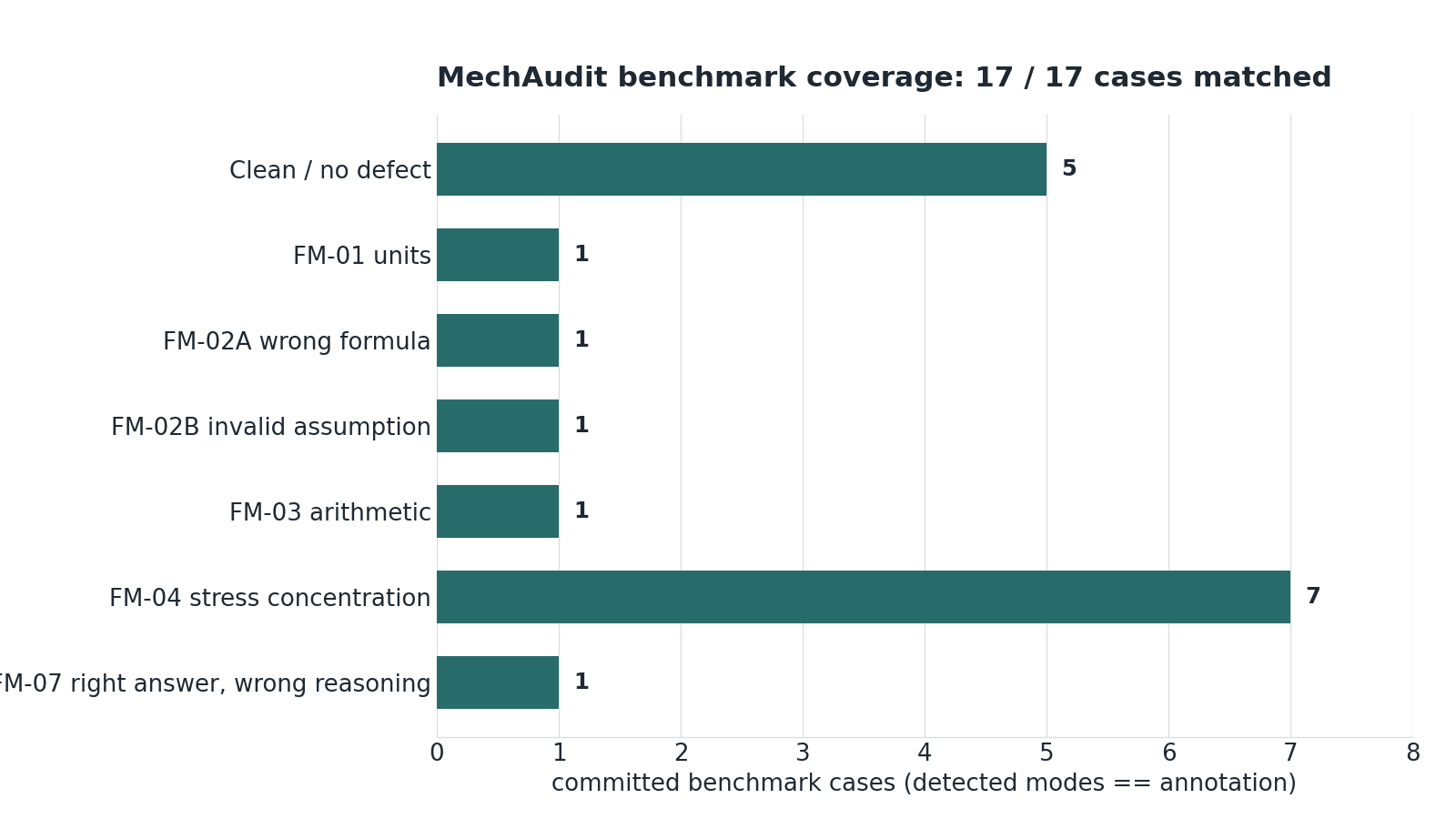
Result. Matched annotated failure modes on 17/17 committed cases across five models by independently recomputing mechanics under a six-category taxonomy.
The verifier loads a structured benchmark case, independently recomputes supported mechanics quantities, extracts the model's reported work, and returns detected failure modes—then compares that set with the case annotation so verifier regressions fail CI. A companion CAD loop builds parametric geometry on a SOLIDWORKS host, checks each build against a closed-form volume oracle before exporting STEP, and solves static FEA on the result, so a future case can cite modeled geometry instead of hand analytics alone.
| Category | AI / Software |
|---|---|
| Timeline | 2026 |
| Status | Complete |
| Evidence | Hash-verified benchmark |
| Role | Verifier design, failure taxonomy, independent recomputation checks, provenance-tracked benchmark capture, CLI, and CI gating |
| Tools | Python, pytest, LLM APIs |
| Links | RepositoryBenchmark results |
problem
My contribution. Built the schema/unit loader, independent calculation and answer-extraction paths, domain checks, failure taxonomy, provenance-tracked capture harness, Markdown audit report, and CI gate.
LLMs produce plausible-looking mechanical-engineering calculations with unit slips, wrong governing formulas, invalid thin-wall assumptions, arithmetic errors, and correct answers reached by incorrect reasoning. A useful verifier must recompute the physics independently and be explicit about the narrow domain it actually covers.
constraints
- Recompute supported quantities independently rather than trusting the model's arithmetic.
- Treat every benchmark case as a hash-verified capture with recorded provenance (elicited versus organic).
- Report only within the covered domain: thin-wall pressure vessels, axial stress, cantilever controls, and finite-width stress concentration.
- Verifier regressions must fail CI against the committed annotation set.
design evolution
Iterations, issues, and fixes, recorded in the order they happened.
| Revision | Failure mode | Design change | Result |
|---|---|---|---|
| Failure taxonomy | “Wrong answer” is too coarse to test a verifier against. | Defined FM-01 units, FM-02A/B formula and assumption, FM-03 arithmetic, FM-04 stress concentration, and FM-07 right-answer/wrong-reasoning. | Each case annotates specific expected failure modes. |
| Independent recomputation | Trusting the model's stated number only re-grades its own claim. | Recompute mechanics from the inputs and compare against the model's extracted reported answer. | Detected modes are computed by the checker, not read from the model. |
| Provenance and CI gate | Elicited and organic captures are different evidence classes. | Hash-verified captures with recorded provenance and a detected-equals-expected gate in CI. | 17 of 17 committed cases match; 2 skipped. |
results
Each committed case pairs an LLM calculation capture with an annotation of expected failure modes; CI passes only when the independently computed detected modes equal that annotation.
The current domain covers thin-wall pressure vessels, axial stress, cantilever controls, and finite-width stress concentration across five models.
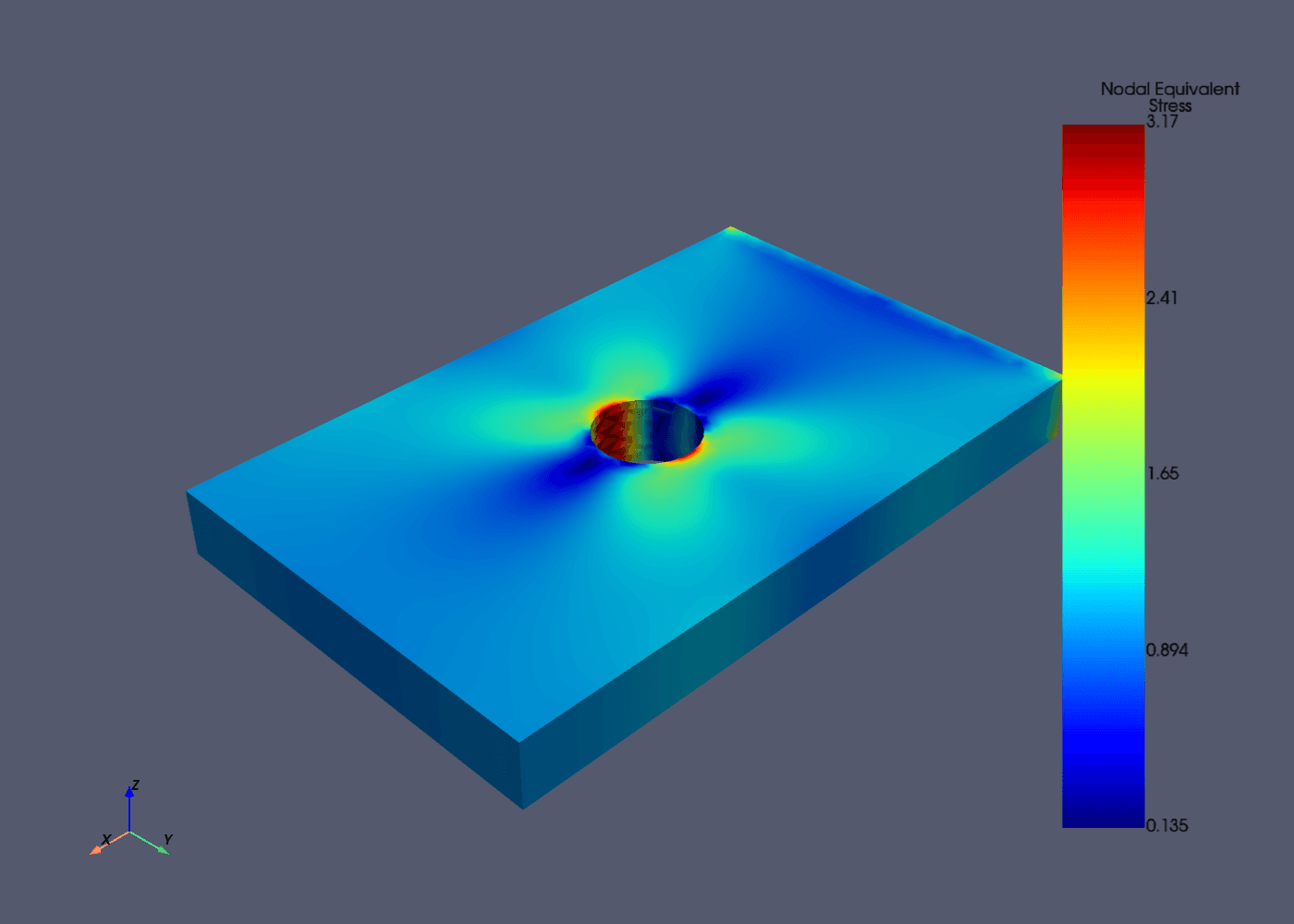
The CAD loop's first solved part is a 6061-T6 mounting plate in tension, meshed at four refinements up to 73,935 elements, whose peak stress at the hole lands within 1.2% of the Heywood and Howland closed-form value. The peak was still moving 7.3% at the finest mesh the solver licence allowed, so that agreement is a cross-check against theory rather than a converged result.
Scope note. Detected modes match annotations on committed elicited captures. This measures the verifier against a bounded benchmark, not overall model capability, and does not yet include organic “wild” failures captured during real engineering work.
lessons
- A failure taxonomy makes verification a checkable detection task instead of a vague judgment.
- Recomputing the physics independently is the only reliable way to catch a correct-looking wrong answer.
- Elicited and organic captures are different evidence classes and must be labeled as such.
gallery