Soft-Robotic-Assistant-for-Physical-Interaction-with-Elderly-and-Rehabilitation-Patients
Literature evidence base and derived design requirements for a compliant upper body that a frail person can lean on, push, or be guided by.
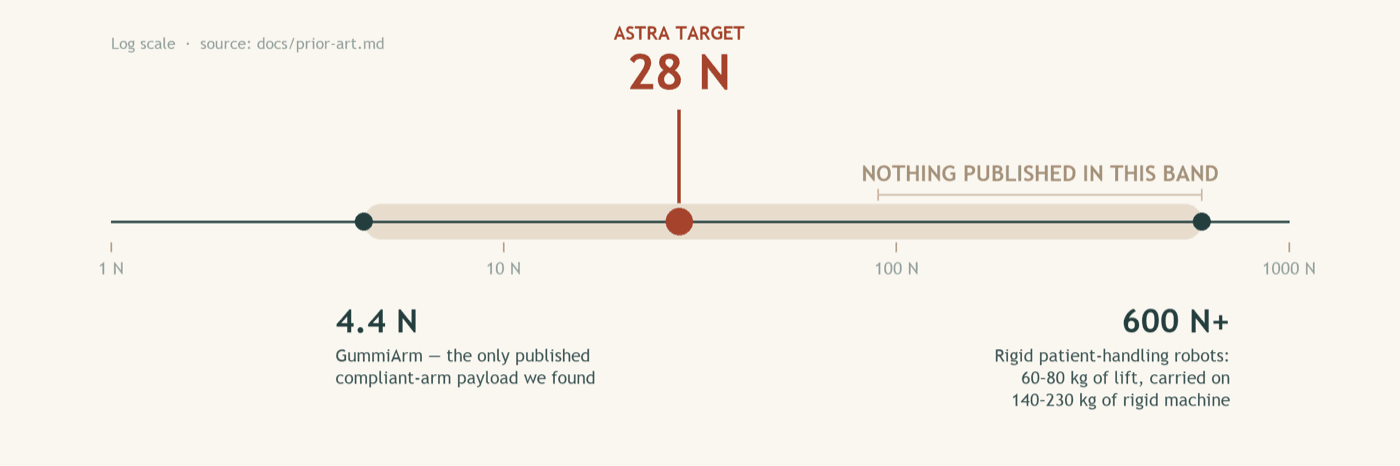
Result. Cut the assistive-force target to 28 N from the tens of newton-metres the brief implied, which brings whole actuator families back into range.
A freestanding compliant upper body that a frail person leans on has to survive contact it does not control. This repository settles what the literature actually supports before any hardware is designed, and it holds no measurements of its own.
| Category | Research |
|---|---|
| Timeline | Sep. 2026 - Present |
| Status | Concept |
| Evidence | Literature and requirements; nothing measured |
| Role | Literature program design, source annotation and grading, requirements derivation, prior-art and patent search, and the evidence-boundary record |
| Tools | Python, BibTeX, Literature matrix, GitHub Actions CI |
| Links | RepositoryDerived requirements |
problem
My contribution. Designed the section structure, annotated and graded 205 sources, derived the requirements table, ran the prior-art and patent searches, and wrote the evidence boundary.
The brief assumed that compliance is what makes contact safe and that the assistive target was tens of newton-metres. Both had to be checked before any actuator was selected, because either error sends the whole build down the wrong path.
constraints
- Every requirement value cites a source or is marked as inferred arithmetic.
- Each source carries an evidence grade and the URL that was actually fetched.
- Record what the literature does not support, not only what it does.
- Claim no compliance with a standard that publishes no contact limits.
design evolution
Iterations, issues, and fixes, recorded in the order they happened.
| Revision | Failure mode | Design change | Result |
|---|---|---|---|
| Force target | The brief implied tens of newton-metres of assistive torque. | Traced the target back to clinical trial evidence and the elbow-extension strength of a weak seated user. | 28 N with a ±6 N modulation band, and actuator families back in range. |
| Safety argument | Compliance does not absorb impact the way the brief assumed. | Followed four independent sections to the same conclusion, then rebuilt the argument around force that is measurable from deflection and bounded when unpowered. | Quasi-static clamping, not head-injury criteria, is the hazard the test campaign must cite. |
| Prior art | A freestanding soft humanoid upper body looked like open ground. | Read the work already occupying it and ran two independent patent searches. | Freestanding patents are rigid and compliant patents are wearable; the claim narrowed. |
results
Nothing here is measured. Every value is transcribed from a published source carrying an evidence grade, a verification note naming the URL that was fetched, and a limitations field; where a source could not be read in full, the numeric field says so rather than carrying a plausible figure.
Two cells are arithmetic rather than citations: shoulder and elbow gravity-compensation torques depend on centre-of-mass moment arms that no source supplies, and both stay marked inferred until they are measured. The governing standard publishes no contact limits, so the limits used here are imported under a documented risk-management argument, which is an argument and not a compliance claim.
Scope note. This is a literature and requirements package. No hardware, simulation, or measurement exists yet.
lessons
- Check the brief's premise first: the force target was off by an order of magnitude, and that decides which actuators are even candidates.
- The most useful result was a negative one, because rebuilding the safety argument around measurable bounded force is a stronger claim than compliance absorbing impact.
- Recording what the sources do not support is what stops the requirements table from being over-read once its numbers start getting quoted elsewhere.
gallery